Scientific publications and research conferences.
https://arccjournals.com/journal/legume-research-an-international-journal/LRF-851
ABSTRACT
Background: Common bean is of the most widely cultivated crops in the world, but climate change and soil fertility depletion are leading to reduced yields, particularly noticeable in recent years. Among the challenges of modern agriculture are, on one hand, increasing the quantity and quality of production and on the other, maintaining a positive balance of macronutrients in the soil. The application of high rates of mineral fertilizers can deteriorate soil properties, while entirely organic fertilization is often insufficient to meet the plants’ requirements. This necessitates the use of an integrated approach when selecting fertilizers.
Methods: An experiment was conducted with common bean (Phaseolus vulgaris ‘Capitano’), grown as a late-season crop in 2023. A randomized block design was utilized with four replications and three fertilization treatments (organic, mineral and combined fertilization). Observations on growth parameters and yield attributes were recorded and analysed using analysis of variance technique.
Result: Common beans exhibit adaptive responses to different fertilization treatments, which influence their development and productivity. The 100% mineral fertilization treatment (266 kg/ha N15P15K15) resulted in the highest values for several key vegetative indicators and a high yield of 10.79 t/ha, as well as maximum nitrogen, phosphorus and potassium content in the plants during the early development stages. In the treatments with entirely organic fertilization (1 t/ha Fertisol), the highest number of nodules in the root system was observed during the Fruiting Stage. However, the slow mineralization of organic fertilizers limited the initial development stages of the beans, reflecting on the final yield. The combined fertilization treatment (500 kg/ha Fertisol + 133 kg N15P15K15) leverages the advantages of both approaches. This treatment showed the highest number of nodules in the root system during the flowering phase, the highest values of plastid pigment content, number of inflorescences, number of leaves, leaf area and plant mass during the second measurement and achieved the highest total yield of 11.18 t/ha. Thus, an integrated fertilization approach is effective for the sustainable management of agroecosystems.
ABSTRACT
Aim: The study aims to assess the effects of heavy metal pollution on soil microbial metabolic activity and functional diversity, and to evaluate the ecological risk near Topolnitsa River by Biolog Ecoplate system.
Material and methods: Five samples (0-20 cm) polluted with Cu and co-contaminants Zn, Pb, Cd, and As were collected from the area near Topolnitsa River and its tributaries: sediment from Medetska River (S1), аdjacent soils of the Topolnitsa River, Medetska River (S2), Zlatishka River (S3), Bunovska River (S4) and cultivated soil around Topolitsa River (S5). The total catabolic activity of bacteria was defined as average well carbon development (AWCD) and community-level physiological profiling (CLPP). The relationships between soil parameters, heavy metal concentration, AWCD, and diversity indices (Shannon (H`), Pielou (E`) and substrate richness (SR)) were analyzed using the Pearson’s correlation statistical test (Past 4.13).
Main results: The soils were classified as slightly polluted S1, S2, S3, and heavily polluted S4 and S5. The AWCD values reflected the microbial community’s metabolic activity across the different sampling sites, with the relatively high activity in S2 and S5. The most easily utilized carbon groups were as follows: CA (carboxylic acids)>AA (amino acids)>AM (amines and amides)>POL (polymers)>CH (carbohydrates)>PHE (phenols) (except S3). The Pearson’s correlation statistical test showed a strong positive correlation between Zn and As, and between Cd and Pb. A perfect correlation was found between the H` and E`, indicating a close relationship between microbial diversity and community balance. Additionally, soil moisture was positively associated with SR and with P2O5.
Conclusion: This study shows that heavy metal pollution influences microbial metabolism and functional diversity in soils near Topolnitsa River. Heavily polluted sites exhibit distinct functional shifts. Correlations between pollutants and microbial indices indicate stress responses. Microbial profiling emerges as a valuable method for ecological risk assessment in industrially impacted ecosystems.
https://agriacad.bg/das_team/magazines/magazine/rastenievydni-nauki-2
ABSTRACT
The objective of this study was to evaluate the residual effects of three fertilization regimes on the content and dynamics of plastid pigments in sweet corn leaves (Zea mays var. saccharata ‘Overland F1’) grown under abiotic stress conditions. A randomized complete block design with four replications was established with the following treatments: T1 – unfertilized control; Т2 Organic fertilization – Fertisol (NPK 4:3:3 + 1.3% MgO и 62% OM); T3 Mineral fertilization – N15K15P15; T4. Combined fertilization – Fertisol + N15K15P15. Chlorophyll a, chlorophyll b, and β-carotene were measured at two growth stages: vegetative (V8–V9) and reproductive (Мilk stage).
At the first measurement, maximum values of total chlorophyll (3.02 mg g-1), chlorophyll a (1.88 mg g-1), and chlorophyll b (1.14 mg g-1) were recorded in treatment T3 (mineral fertilization), while the lowest values were observed under organic fertilization (T2: 1.26 mg g-1 and 0.82 mg g-1). During the reproductive stage, total chlorophyll content decreased in all treatments except T4 (combined), where chlorophyll a increased from 1.26 to 1.83 mg g-1 (+15.4%) and the Chl a/b ratio increased to 3.40, likely due to delayed pigment degradation and extended green period.
These results demonstrate that the integrated organic-mineral approach can optimize plant nutrition by combining the rapid action of mineral fertilizers with the prolonged effect of organic sources. This leads to extended photosynthetic activity and enhanced yield potential under changing climate conditions.
Nikolova, R., Dimitrova, G., Gatev, E., Dinev, N., Radeva, G. (2024). Community-level physiological profiles of bacterial communities inhabiting heavy metal-polluted soils. International Seminar of Ecology – 2024 in „Global Change Ecology“, 26-27.09.2024, Sofia, Bulgaria.
ABSTRACT
The study aimed to assess the differences in the functional profiles of bacterial communities from heavy metal/b id (Zn, Pb, Cd, Cu and As) polluted soils. Topsoil samples (0-20 cm) were collected in April 2022 from the area of non-ferrous metal plant KCM 2000 Group, near Plovdiv region, Southern Bulgaria. Four soil samples per site were drawn from two locations: KCM and Dolni Voden (DV). The Nemerow’s pollution index (NPI) was calculated to evaluate the soil samples’ overall pollution of heavy metals. Patterns in utilization of various carbon sources of soil bacterial communities were evaluated by using community level physiological profiling (CLPP) applying the BIOLOG EcoPlate method (Biolog, Inc., USA). Substrate richness, Shannon and Pielou indices were calculated to assess the functional diversity and distribution of the functional profiles of the bacterial communities. According to the NPI, the soils were classified as heavily (KCM) and lightly polluted (DV). BIOLOG EcoPlate analysis showed differences in the metabolic activity of bacterial communities between the DV and KCM soils. The highest levels of adverse impacts were recorded in heavily polluted soils, significantly reducing overall microbial activity. Bacterial communities from KCM predominantly utilized polymers (Polym) and carbohydrates (CH), while those from DV showed a preference for amines/amides (Amin). Substrate richness and Shannon indices indicated a reduction in functional diversity in KCM soils compared to DV soils. The Pielou index showed a more even distribution of functional profiles in KCM soils. Heavy metal pollution in soil affected negatively the catabolic activity of bacterial communities, reducing their ability to metabolize soil organic matter.
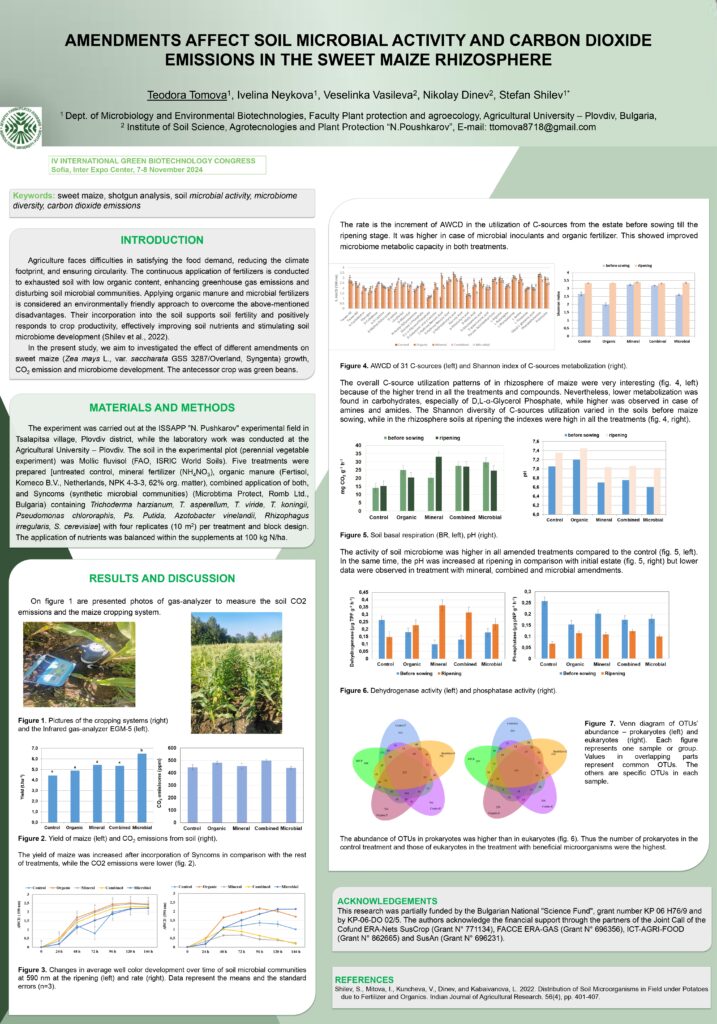
Tomova, T., Neykova, I., Vasileva, V., Dinev, N., Shilev, S. 2024. Amendments affect soil microbial activity and carbon dioxide emissions in the sweet maize rhizosphere. IV International Green Biotechnology Congress “Biotechnology for agricultural sustainability in the era of climate change”.
Radeva, G., Dimitrova, G., Petkova, M., Nikolova, R., Gatev, E., Dinev, N., Hristova, M., Hristova, V. (2025). Impact of heavy metal pollution on microbial functional diversity in soils near Topolnitsa River, Southern Bulgaria, International Seminar of Ecology – 2025 in “Modern Ecology – Theoretical and Applied View“, 25-26.09.2025, Sofia, Bulgaria.
ABSTRACT
The study aims to assess the effects of heavy metal pollution on soil microbial metabolic activity and functional diversity, and to evaluate the ecological risk near Topolnitsa River by Biolog Ecoplate system. Five samples (0-20 cm) polluted with Cu and co-contaminants Zn, Pb, Cd, and As were collected from the area near Topolnitsa River and its tributaries: sediment from Medetska River (S1), аdjacent soils of the Topolnitsa River, Medetska River (S2), Zlatishka River (S3), Bunovska River (S4) and cultivated soil around Topolitsa River (S5). The total catabolic activity of bacteria was defined as average well carbon development (AWCD) and community-level physiological profiling (CLPP). The relationships between soil parameters, heavy metal concentration, AWCD, and diversity indices (Shannon (H`), Pielou (E`) and substrate richness (SR)) were analyzed using the Pearson’s correlation statistical test (Past 4.13). The soils were classified as slightly polluted S1, S2, S3, and heavily polluted S4 and S5. The AWCD values reflected the microbial community’s metabolic activity across the different sampling sites, with the relatively high activity in S2 and S5. The most easily utilized carbon groups were as follows: CA (carboxylic acids)>AA (amino acids)>AM (amines and amides)>POL (polymers)>CH (carbohydrates)>PHE (phenols) (except S3). The Pearson’s correlation statistical test showed a strong positive correlation between Zn and As, and between Cd and Pb. A perfect correlation was found between the H` and E`, indicating a close relationship between microbial diversity and community balance. Additionally, soil moisture was positively associated with SR and with P2O5. This study shows that heavy metal pollution influences microbial metabolism and functional diversity in soils near Topolnitsa River. Heavily polluted sites exhibit distinct functional shifts. Correlations between pollutants and microbial indices indicate stress responses. Microbial profiling emerges as a valuable method for ecological risk assessment in industrially impacted ecosystems.
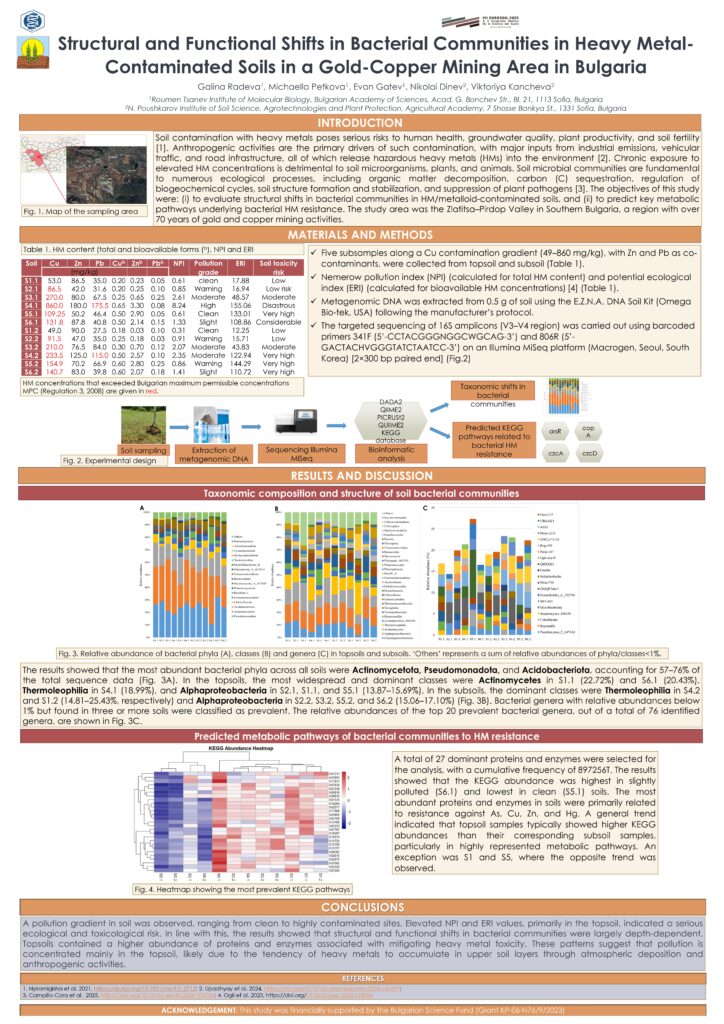
Radeva, G., Petkova, M., Gatev, E., Dinev, N., Kancheva, V. (2025). Structural and Functional Shifts in Bacterial Communities in Heavy Metal-Contaminated Soils in a Gold-Copper Mining Area in Bulgaria. VII EuroSoil 2025 & X Iberian Congress of Soil Science, 08-12.08.2025, Seville, Spain.
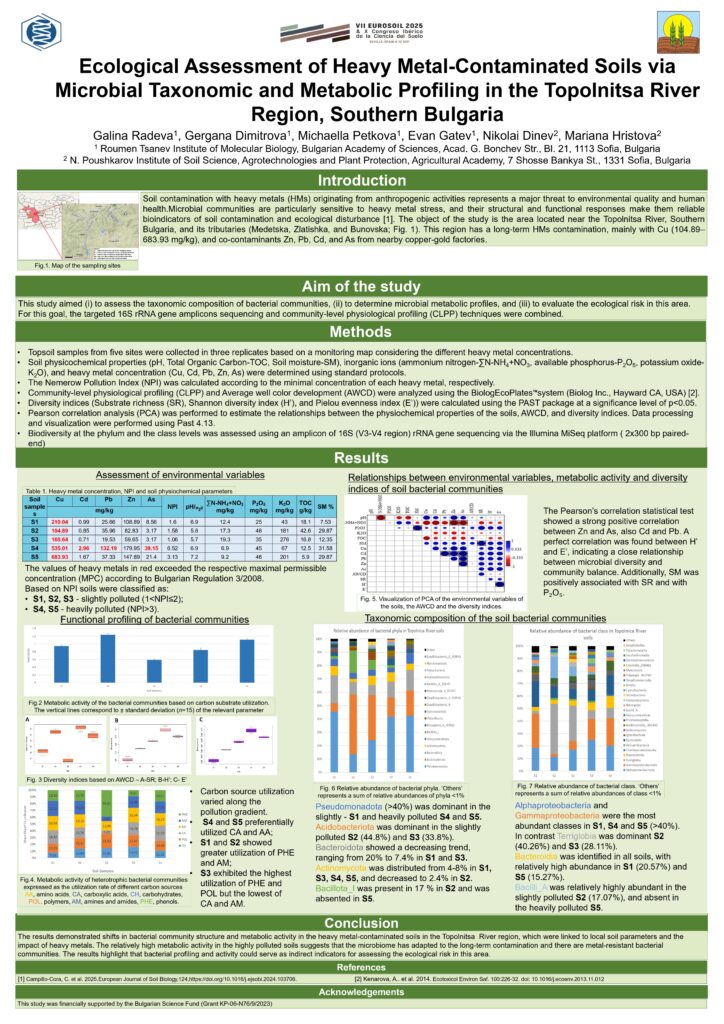
Radeva, G., Dimitrova, G., Petkova, M., Gatev, E., Dinev, N., Hristova, M. (2025). Ecological Assessment of Heavy Metal-Contaminated Soils via Microbial Taxonomic and Metabolic Profiling in the Topolnitsa River Region, Southern Bulgaria’, VII EuroSoil 2025 & X Iberian Congress of Soil Science, 08-12.08.2025, Seville, Spain.
Томова, Т., Василева, В., Попова, В., Нейкова, И., Динев, Н., Шилев, С. (2025). Типът торене оказва съществено влияние върху структурата на почвения микробиом на сладката царевица, НАУЧЕН ФОРУМ „РЕВОЛЮЦИИ И ЕВОЛЮЦИИ“, Студентски съвет – ПУ „Паисий Хилендарски“, 23-25.04.2025г., Пловдив, България.
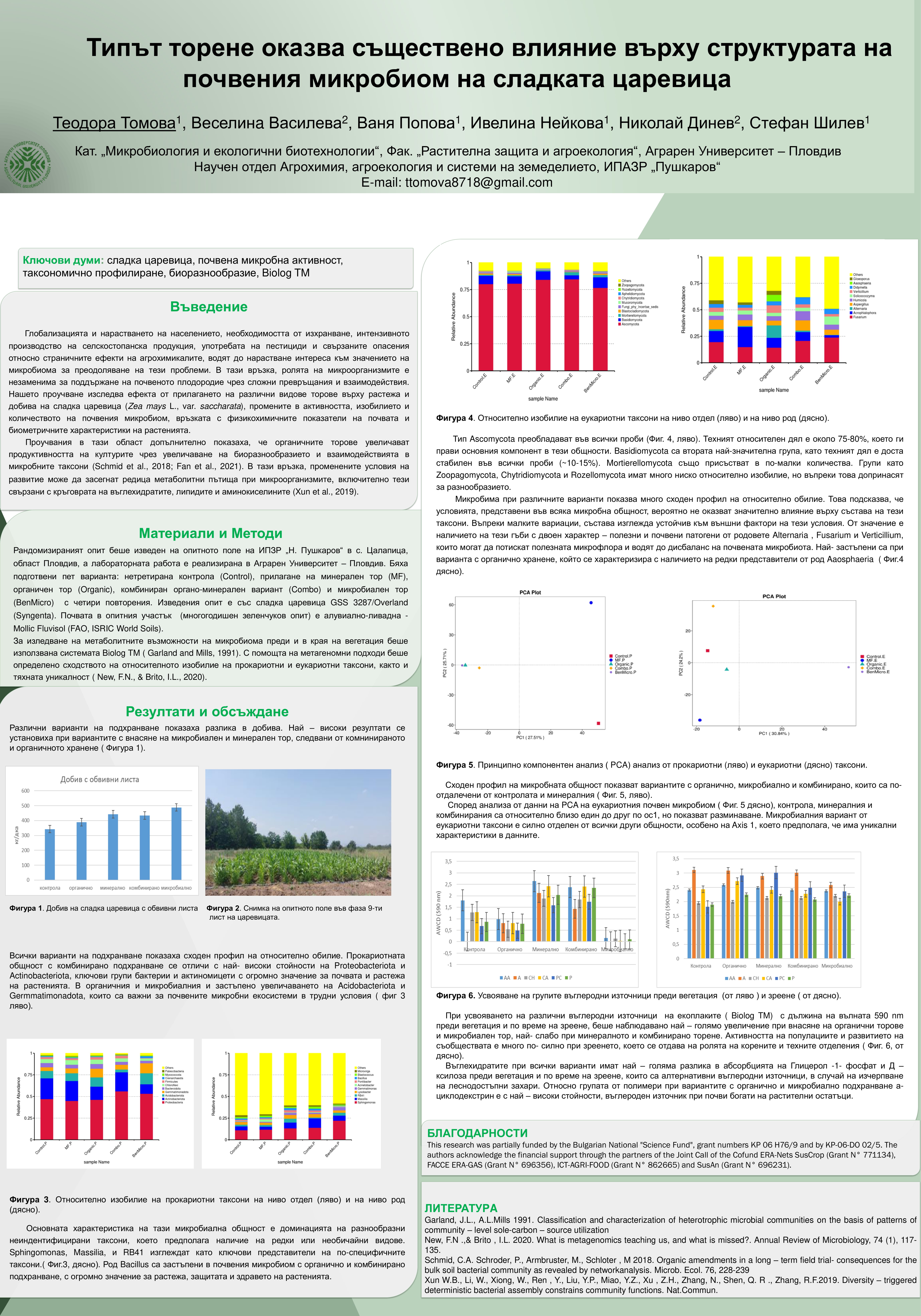
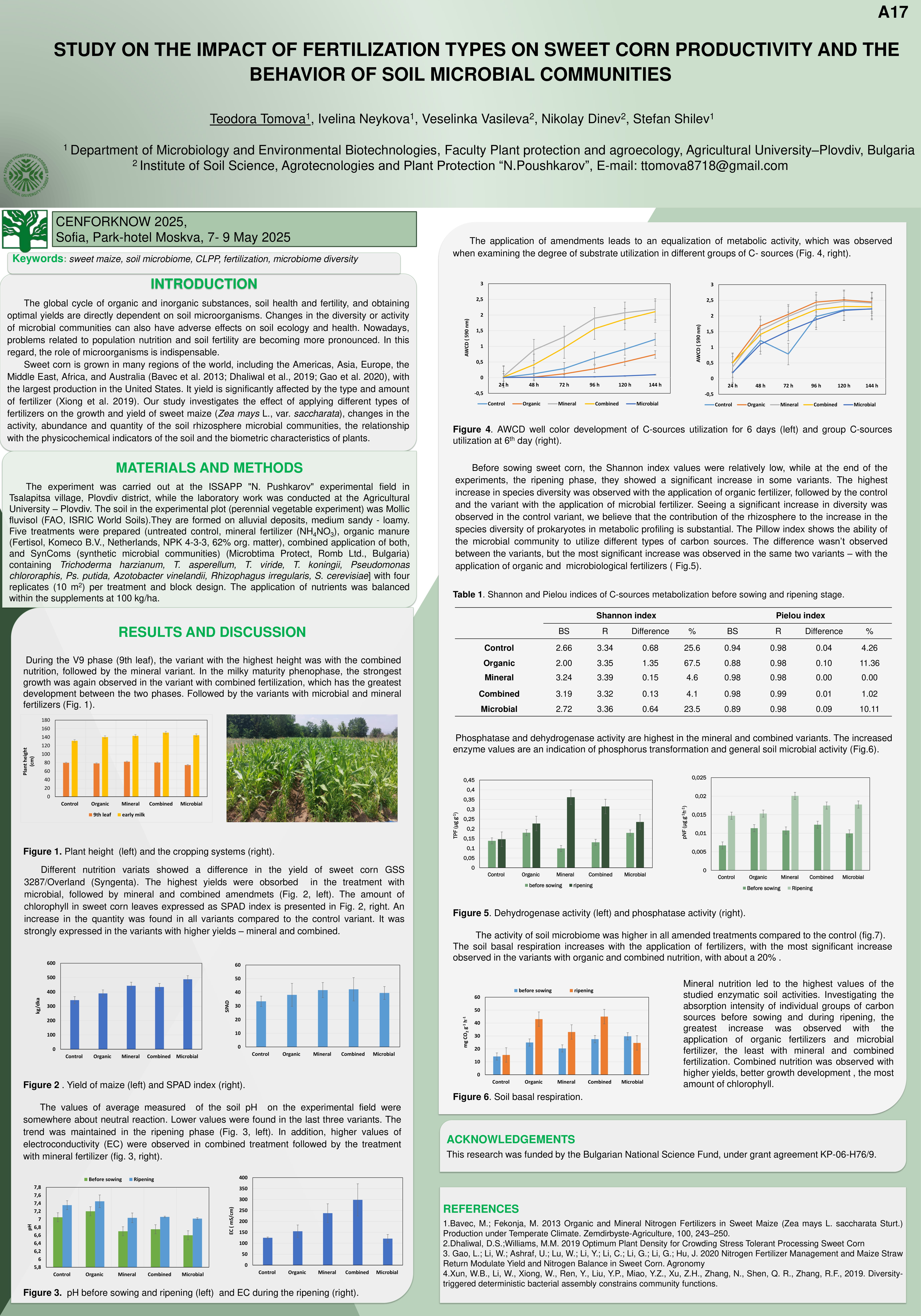
Tomova, T., Neykova, I., Vasileva, V., Dinev, V., Shilev, S. (2025). Study on the impact of fertilization types on sweet corn productivity and the behavior of soil microbial communities, “A century of forest knowledge – education, innovations, challenges” (CENFORKNOW 2025), Sofia, Park-hotel Moskva, 7-9 May 2025.